
 Security Product Engineering















The race to adopt large language models is accelerating. Every AI-driven enterprise wants generative AI in place, whether for customer support, automation, analytics, or internal productivity.
But there's a catch. Organizations don't want to compromise on security, data privacy, or infrastructure control. Sending sensitive data to external APIs or public cloud services is often not an option. As a result, more teams are choosing to deploy LLMs on edge devices or on-premises servers.
This shift introduces a new challenge: how do you achieve cloud-like scalability, load distribution, and efficiency while staying fully on-prem?
Enterprise LLM inference platform architecture
Deploying large language models in an enterprise environment requires more than simply hosting models on local infrastructure. Production-grade systems must handle:
- Highly variable and bursty request patterns
- Efficient utilization of expensive GPU resources
- Concurrent access from multiple teams and applications
- Strict requirements for latency, reliability, and security
A robust architecture must therefore be scalable, cost-efficient, observable, and secure, while operating within on-premise or hybrid environments.
Request flow and API layer
Inference is exposed through a standardized API interface:
POST /v1/models/{model}:predict
This API acts as the entry point for all AI workloads, enabling:
- Internal applications such as search, summarization, and assistants
- External or customer-facing services
- Unified access to multiple model backends
Intelligent routing layer
Requests hitting that endpoint are not sent straight to a model. To manage uneven traffic distribution and prevent resource bottlenecks, an AI gateway layer is introduced, such as LiteLLM or Envoy AI Gateway. Its responsibilities include:
- TLS/SSL termination for secure communication
- Authentication and request validation
- Intelligent request routing across model replicas
- Load balancing and failover handling
- Advanced deployment strategies such as A/B testing and canary releases
This layer ensures optimal utilization and high availability of model services.
Serverless execution with Knative
Static resource allocation leads to inefficient GPU utilization, especially during idle periods. Knative addresses this by enabling serverless behavior within Kubernetes:
- Scale-to-zero when no traffic is present
- Rapid scale-up on incoming requests
- Autoscaling based on real-time traffic
This results in cloud-like elasticity within on-prem infrastructure, significantly reducing idle compute costs.
Model serving with KServe
Once capacity can scale elastically, KServe handles the actual model serving. It acts as the core model serving layer, providing a standardized and extensible framework built around:
- Declarative model deployment
- Multi-runtime support, including vLLM for optimized LLM inference, Hugging Face Transformers, NVIDIA Triton, and custom runtimes
- Modular inference pipelines, split into predictors for core model execution and transformers for pre- and post-processing
- Flexible storage integration
This enables rapid experimentation, model switching, and workload scaling without infrastructure changes.
Observability with Prometheus
Operational visibility is critical for performance tuning and reliability. Prometheus is used to collect real-time metrics such as:
- Request throughput
- Queue depth
- GPU utilization
- Latency and response times
This enables data-driven decision-making and proactive system management.
Event-driven autoscaling with KEDA
While monitoring provides insights, KEDA (Kubernetes Event-Driven Autoscaling) enables automated response. It consumes metrics from Prometheus and dynamically adjusts workloads using ScaledObjects, following simple scaling logic:
- Increase replicas during traffic spikes
- Reduce resources during low utilization
- Scale based on queue length and system load
This ensures a self-adjusting system with minimal manual intervention.
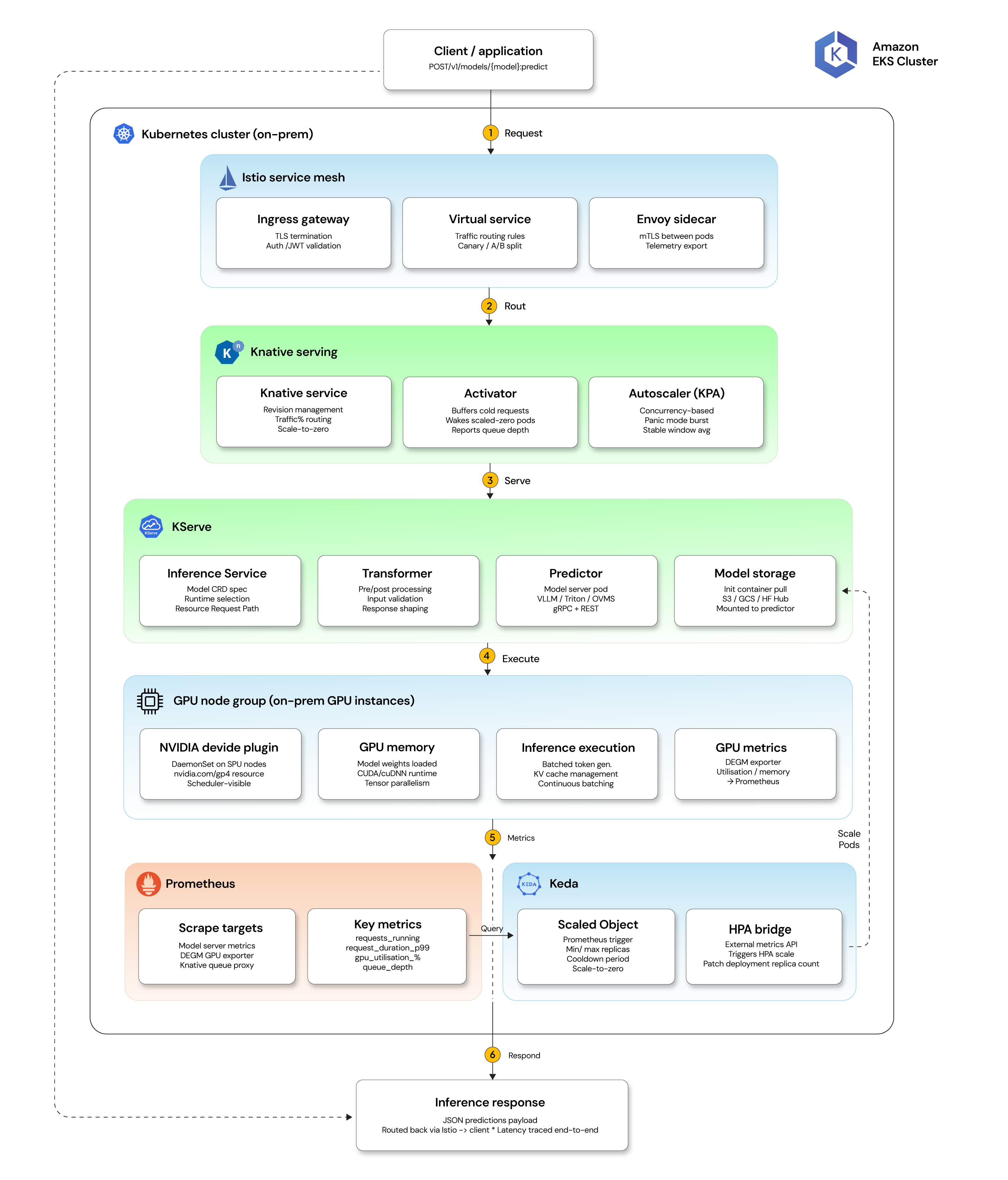
End-to-end architecture flow
Put together, a single request moves through the platform in sequence:
- Requests enter via a secure API gateway
- Traffic is authenticated, validated, and routed intelligently
- Knative manages serverless execution and scaling
- KServe handles model inference
- GPUs accelerate computation
- Prometheus collects system metrics
- KEDA dynamically adjusts resource allocation
- Responses are returned with low latency
The diagram below shows this flow implemented on a Kubernetes cluster.
Business outcomes
Combining these components delivers:
- Data privacy and control: fully on-prem deployment
- Performance: high-throughput, low-latency inference
- Cost efficiency: reduced GPU waste through scale-to-zero
- Scalability: automatic adaptation to workload demand
- Flexibility: support for multiple models and runtimes
Putting this into production
Modern enterprise AI platforms require tightly integrated components across serving, scaling, routing, and observability. By combining KServe for model serving, Knative for serverless execution, KEDA for event-driven autoscaling, and Prometheus for monitoring, organizations can build self-optimizing, production-grade LLM inference systems that balance performance, cost, and control.
Teams working on on-premises LLM inference and looking for engineering support can turn to Opcito. The team has hands-on experience building this kind of stack, from Kubernetes-native model serving to full MLOps pipelines, and works as an extension of the client's engineering team rather than a separate vendor. Whether starting from scratch or scaling an existing setup, Opcito can help move faster without cutting corners. Get in touch with Opcito to talk through the specifics.
Comments
Related Blog /Articles




Ready to transform your FinTech Application?
Explore our VAPT as a Service portfolio or speak with our team to discuss your security testing requirements.