
 Security Product Engineering












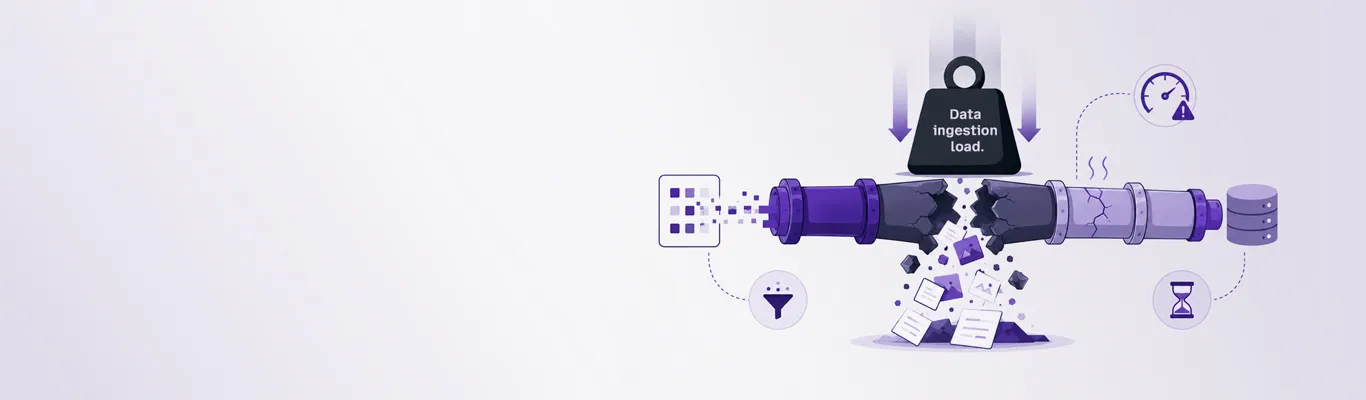


Retrieval-Augmented Generation (RAG) has quickly become the backbone of enterprise AI applications. From intelligent customer support systems to AI copilots and internal knowledge assistants, companies everywhere are racing to deploy RAG-powered products.
The demos look impressive. The prototypes work flawlessly. Then traffic hits.
Suddenly, response times spike. Hallucinations increase. Infrastructure costs explode. Users lose trust. Sales teams stop showcasing the product. CTOs start questioning scalability. Engineering teams scramble to patch production RAG issues that should have been anticipated months earlier.
This is the uncomfortable reality many organizations face: most RAG pipelines are designed for demos, not production-scale workloads.
The challenge is not simply building a RAG system. The real challenge is building one that performs reliably under enterprise load while maintaining speed, accuracy, observability, and cost efficiency.
In this blog, we'll break down:
- What a modern production RAG pipeline actually looks like
- Why RAG systems fail under scale — and the specific RAG failure points at scale most teams miss
- The architectural bottlenecks most teams overlook
- How leading engineering organizations solve these issues
- Practical strategies to build production-grade RAG infrastructure
What is a production RAG pipeline?
Before diving into failures, let's establish a simple understanding of RAG.
Retrieval-Augmented Generation (RAG) combines:
- Retrieval Systems — Search relevant information from external data sources
- Large Language Models (LLMs) — Generate contextual responses using retrieved information
Instead of relying solely on the model's training data, RAG enables AI systems to fetch fresh, domain-specific knowledge in real time.
A typical production RAG architecture includes:
- Document ingestion
- Chunking and preprocessing
- Embedding generation
- Vector database indexing
- Semantic retrieval
- Re-ranking
- Prompt orchestration
- LLM response generation
- Monitoring and feedback loops
This architecture dramatically improves accuracy, freshness of information, enterprise customization, and compliance and governance.
But every additional component introduces operational complexity — and complexity becomes dangerous under load.
Why most production RAG pipelines collapse at scale
The gap between a working RAG demo and a stable production RAG system is significant. Understanding where and why this gap widens is the first step toward fixing it.
The demo-to-production gap in RAG deployments
Most RAG systems are initially tested with small document sets, limited concurrent users, predictable prompts, and minimal latency pressure.
Production environments are completely different.
Real enterprise workloads include thousands of simultaneous requests, multi-region deployments, massive vector indexes, real-time document updates, complex permission filtering, and multi-step retrieval orchestration.
Under these conditions, weak production RAG architectures become visible immediately.
The result? Slow inference, inconsistent retrieval quality, infrastructure bottlenecks, API saturation, and runaway cloud bills.
The core issue is simple: many teams optimize for AI capability before optimizing for systems engineering.
5 production RAG failure points under enterprise load
Each of the following bottlenecks can independently degrade a production RAG system. Under real enterprise load, they typically occur together — compounding latency, cost, and reliability failures.
1. Retrieval latency becomes your biggest production RAG bottleneck
Retrieval is the first bottleneck that surfaces when you move from prototype to production. Here is what causes it and how to address it.
Why RAG retrieval latency degrades at scale
As vector databases grow, retrieval performance often degrades dramatically.
What worked perfectly with 50,000 vectors starts failing with 50 million vectors. Latency compounds across embedding lookup, Approximate Nearest Neighbor (ANN) search using HNSW (Hierarchical Navigable Small World) indexing, metadata filtering, re-ranking layers, and cross-encoder evaluation.
Now multiply that by hundreds or thousands of concurrent requests. RAG high concurrency is where vector search performance deteriorates most visibly — your "fast AI assistant" suddenly becomes unusable.
Why leadership should care about RAG latency issues
Slow retrieval impacts customer experience, conversion rates, sales demos, employee productivity, and SLA commitments. Even a few seconds of additional latency can significantly reduce adoption.
How to fix production RAG retrieval latency
- Implement Multi-Tier Retrieval: Use hot storage for frequently accessed vectors and cold storage for archival data.
- Use Hybrid Search: Combine semantic vector search, keyword/BM25 search, and metadata-aware filtering to reduce RAG retrieval latency. This reduces unnecessary vector operations while improving retrieval accuracy. Vector databases like Pinecone, Weaviate, and Qdrant each offer native hybrid search support with different performance trade-offs at scale.
- Optimize Chunking Strategy: Poor RAG chunk size optimization causes more retrieval calls, larger context windows, and higher token costs. Smarter chunking reduces retrieval overhead substantially.
- Introduce Query Caching and Semantic Caching: Many enterprise prompts are repetitive. Caching retrieval outputs, embeddings, and final responses — including semantic caching for near-duplicate queries — can reduce infrastructure costs dramatically.
2. Context window explosion destroys production RAG performance
Context bloat is often invisible until it starts driving up costs and degrading answer quality. It deserves the same engineering attention as retrieval latency.
The silent killer of RAG systems at scale
Many teams assume more context equals better answers. This is rarely true.
As organizations add more retrieved chunks, longer documents, additional system prompts, and tool outputs, the context window becomes bloated — a pattern commonly referred to as context window overflow in RAG systems.
Consequences include higher token costs, slower inference, reduced answer quality, increased hallucinations in production, and context dilution. Ironically, larger context often reduces precision.
The real enterprise cost of context inefficiency
For leadership teams, context inefficiency in production RAG translates directly into escalating AI operational costs, poor scalability economics, and unpredictable infrastructure spend. RAG infrastructure cost optimization at the context layer — not just the retrieval layer — is where the largest savings are typically found. Some organizations unknowingly spend millions annually on unnecessary token processing.
How to fix context window overhead in production RAG
- Use Intelligent Re-Ranking: Instead of passing 20 chunks to the LLM, retrieve 20, re-rank aggressively, and send only the top 3–5.
- Apply Context Compression: Compress retrieved content into summaries, structured facts, and relevance-aware snippets.
- Build Domain-Specific Retrieval Pipelines: Not every query requires the same retrieval depth, the same embedding model, or the same prompt orchestration. Adaptive pipelines improve efficiency significantly.
3. Embedding pipeline failures under real-time production workloads
Retrieval gets most of the attention, but the embedding pipeline is where many production RAG systems silently degrade. Ingestion failures don't surface as errors — they surface as stale or inaccurate answers.
Why embedding bottlenecks emerge in production RAG
Embedding generation is computationally expensive. When enterprises ingest PDFs, knowledge bases, Slack messages, CRM records, and support tickets at scale, embedding systems become overloaded quickly. At this volume, it is also worth noting that ingestion pipelines handling sensitive data carry their own risks — accidental data leakage during AI training and ingestion is a common but underexamined failure mode in enterprise deployments.
This creates indexing backlogs, stale knowledge retrieval, synchronization delays, and increased infrastructure pressure — a classic RAG embedding bottleneck.
The business impact of stale embeddings
For customer-facing AI products, stale retrieval means outdated answers, compliance risks, and customer distrust. In regulated industries, this can become a serious governance issue.
How high-performing teams solve production RAG embedding problems
Use Incremental Indexing: Avoid rebuilding entire indexes repeatedly. Instead, detect document changes, re-embed selectively, and update vectors asynchronously.
Separate Ingestion from Retrieval Infrastructure: Do not overload production retrieval systems with ingestion workloads. Use dedicated ingestion queues, streaming architectures, and background indexing workers. An asynchronous RAG pipeline that decouples ingestion from retrieval is the standard pattern for enterprise-scale deployments.
Introduce Embedding Versioning: Embedding models evolve. Without version control, retrieval quality becomes inconsistent and search behavior drifts unpredictably. Versioning ensures observability and rollback safety.
4. Missing observability is a critical production RAG architecture gap
Without observability, production RAG pipelines operate as black boxes. Teams can't detect retrieval degradation, measure answer quality, or trace failures to their root cause.
The industry-wide RAG observability blind spot
Many organizations monitor API uptime, CPU usage, and token consumption — but fail to monitor retrieval quality, chunk relevance, hallucination frequency, prompt drift, and embedding degradation. RAG observability tracing — correlating request IDs end-to-end across retrieval, re-ranking, and generation — is missing from most production stacks.
This creates dangerous blind spots. Teams often discover production RAG problems only after customers complain.
Why CTOs must prioritize production RAG monitoring
Without observability, scaling becomes risky, root-cause analysis slows down, AI governance weakens, and enterprise trust declines. Modern production RAG systems require AI-native observability stacks.
What to measure in a production RAG observability strategy
Retrieval Metrics
- Retrieval precision
- Recall quality
- Latency distribution
- Failed retrieval rates
LLM Metrics
- Hallucination frequency
- Token efficiency
- Prompt success rates
- Context utilization
Infrastructure Metrics
- Vector DB throughput
- GPU utilization
- Queue delays
- Cost per request
5. Security and multi-tenancy failures in enterprise RAG deployments
Security failures in production RAG systems are not edge cases. As deployments expand to multiple teams, clients, or geographies, permission and isolation gaps create serious exposure.
The hidden scaling problem in enterprise RAG architecture
As organizations expand RAG deployments across teams or clients, permission complexity grows exponentially.
Without proper isolation, users may retrieve unauthorized data, cross-tenant leakage becomes possible, and compliance violations emerge. This is especially dangerous in healthcare, finance, legal, and government sectors. These risks are compounded when prompt design is not security-aware — context engineering introduces its own security risks that are distinct from infrastructure-level access control and deserve separate attention.
Enterprise buyers now ask hard security questions
Modern AI procurement discussions increasingly include data residency, tenant isolation, retrieval authorization, auditability, and encryption standards. If your production RAG architecture cannot answer these confidently, enterprise deals become difficult.
How to fix security gaps in production RAG systems
- Implement Metadata-Aware Access Control: Every vector should include user permissions, organizational scope, and data classification tags.
- Use Retrieval-Time Authorization: Authorization should happen before retrieval results reach the LLM — not after.
- Build Audit Logging: Track retrieved documents, prompt history, user access patterns, and generated outputs. This improves governance, compliance, and incident investigation.
Production RAG architecture best practices: a systems engineering checklist
The next wave of AI winners will not simply have better prompts, bigger models, or more embeddings. They will have better infrastructure, better orchestration, better observability, and better scaling architectures.
Enterprise buyers are becoming more sophisticated. They no longer ask "Can your AI work?" They ask "Can your AI scale reliably, securely, and cost-effectively?" That changes everything.
Here's what modern production-grade RAG systems should include:
Performance: retrieval speed and RAG latency optimization
- Hybrid retrieval (vector + BM25)
- Semantic caching and query caching
- Intelligent chunking and RAG chunk size optimization
- Adaptive context management
Reliability: fault tolerance in production RAG systems
- Retry orchestration
- Circuit breakers
- Queue-based ingestion
- Graceful degradation
Observability: monitoring and tracing for production RAG
- Retrieval analytics
- Hallucination monitoring
- Prompt evaluation pipelines
- Cost monitoring dashboards
Security: access control and compliance in enterprise RAG
- Tenant isolation
- Retrieval authorization
- Encryption at rest and in transit
- Audit logging
Scalability: distributed infrastructure for production RAG deployments
- Distributed vector databases
- GPU autoscaling
- Streaming ingestion pipelines
- Multi-region deployment support
Building reliable production RAG requires systems engineering discipline
RAG is no longer an experimental AI pattern. It is rapidly becoming core infrastructure for enterprise intelligence systems.
But the organizations that succeed with production RAG at scale are not merely building AI features — they are building resilient AI systems. The difference matters.
A production-grade RAG pipeline requires distributed systems thinking, retrieval engineering, observability discipline, infrastructure optimization, and a security-first architecture. What separates a production-ready RAG solution from a fragile prototype is not the model — it is the engineering discipline applied to every layer around it. Organizations that invest in scalable RAG architecture early avoid the costly refactoring that comes with reactive fixes under load.
The companies that understand this early will gain a significant competitive advantage — because in enterprise AI, the biggest differentiator is no longer model access. It's operational excellence.
If you're evaluating your current RAG architecture or planning a production deployment, our engineers are happy to help you work through it.
Comments
Related Blog /Articles




Ready to transform your FinTech Application?
Explore our VAPT as a Service portfolio or speak with our team to discuss your security testing requirements.