
 Security Product Engineering












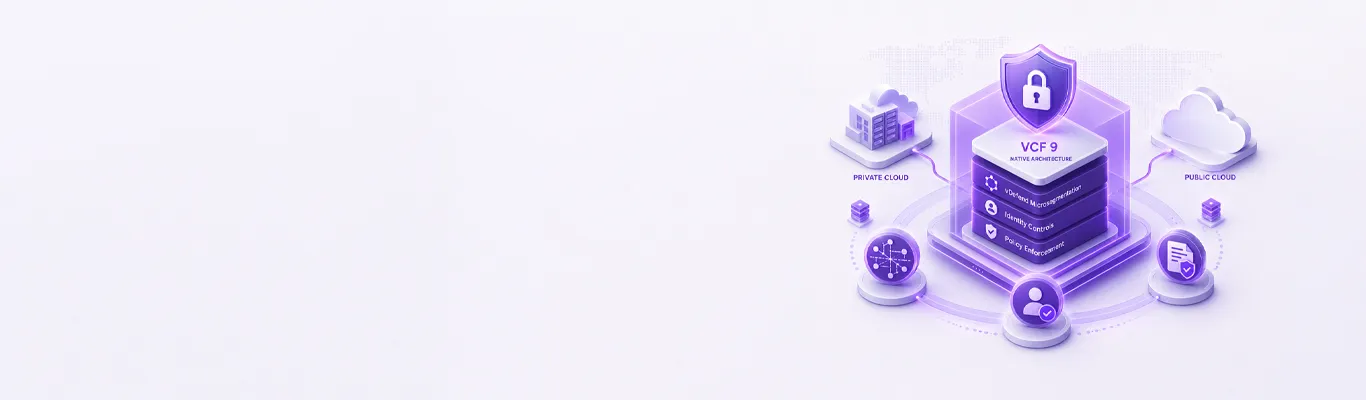


VMware VCF private cloud security in hybrid environments demands an architecture where controls are native to the infrastructure — not added on top. VCF 9 with vDefend brings microsegmentation, identity-based access, and automated policy enforcement together in a single management plane that spans on-premises and cloud domains.
For CTOs and security leaders at ISVs, a fragmented security posture is not just a technical problem — it is a delivery risk. When controls differ between on-premises and cloud environments, teams spend engineering cycles chasing misconfigurations and compliance gaps instead of shipping product. VMware Cloud Foundation security resolves this by enforcing controls at the infrastructure layer, eliminating the tool sprawl that drives those inefficiencies.
Why does hybrid cloud security remain fragmented in 2026?
Quick answer: Hybrid cloud environments span multiple platforms, each with its own security tools, logs, and access controls. This creates structural blind spots — the exact conditions attackers exploit.
Secure hybrid VMware environments require consistent policy enforcement across every domain. Each domain — on-premises data center, private cloud, public cloud — runs its own security tooling, logs, and access controls. Where those domains connect, gaps appear. Attackers exploit those gaps. The 2026 Cloud Security Report, based on a survey of over 1,163 senior cybersecurity professionals, found that nearly 70% of organizations identify tool sprawl and visibility gaps as their primary barrier to effective hybrid cloud security for VMware and other enterprise platforms.
IBM's X-Force Incident Response documented a consistent pattern throughout 2025: most cloud breaches were not the result of sophisticated exploits. They traced back to misconfigurations in identity controls and weaknesses in how on-premises and cloud environments were integrated. In several cases, attackers used those integration points — specifically, Active Directory synchronization components — to escalate privileges and move laterally into cloud assets. That is the practical consequence of an inconsistent hybrid security posture.
For small and mid-scale ISVs, this is not a theoretical concern. Security incidents consume unplanned engineering capacity, stall compliance certifications, and can directly affect customer contracts. Getting the architecture right from the start costs far less than remediating a breach.
What makes VMware VCF private cloud security different from legacy approaches?
VCF 9 enforces security at compute, network, and storage layers simultaneously — by design. vDefend operates natively within VMware Cloud Foundation so that every ESXi host becomes an enforcement point, giving teams full traffic visibility without agent sprawl.
VCF 9 is built on a continuous verification model rooted in VMware's zero-trust architecture. The platform applies policy-driven controls at compute, network, and storage layers simultaneously. Nothing in the environment is implicitly trusted — every action is verified before it proceeds. This replaces the bolt-on, perimeter-first model that leaves hybrid environments exposed.
vDefend operates natively within that architecture. Instead of deploying discrete agents per workload, every ESXi host becomes an enforcement point. Traffic is inspected at the hypervisor layer — exactly where workloads communicate — giving security teams complete visibility into east-west and north-south flows without adding operational complexity. This approach also supports VMware vSphere hardening at scale, since enforcement is embedded directly into the compute fabric rather than layered on top of it.
How does VMware vDefend enforce zero-trust lateral security on VCF?
VMware vDefend is a software-defined security layer built into VCF. It enforces zero trust through microsegmentation, network detection and response (NDR), and automated firewall rule management — all within a single management plane.
vDefend protects all VMware workload security requirements — both business-critical and standard — without requiring separate agent infrastructure or third-party tooling.
The vDefend DFW 1-2-3-4 workflow addresses the two most common zero-trust rollout problems: identifying where your current segmentation gaps are and closing them quickly. The workflow guides teams through a structured sequence. It starts with shared infrastructure services — DNS, DHCP, Active Directory — then builds outward to zone-level segmentation and finally to granular, application-level VMware NSX microsegmentation. According to Broadcom, most organizations can complete an initial deployment within a few weeks using this automated, prescriptive approach.
What are the top VCF security controls for consistent hybrid cloud policy enforcement?
The best controls for hybrid environments combine vDefend microsegmentation, VCF Advanced Cyber Compliance for automated drift detection, and identity federation for centralized access governance. Together, they eliminate the policy inconsistency that creates breach conditions.
How does VCF 9 handle identity and access across hybrid domains?
Identity is the most commonly exploited entry point in hybrid environments. Static roles, orphaned accounts, and inconsistent authentication across domains give attackers persistent access that can go undetected for weeks. VCF 9 addresses this by integrating with enterprise identity providers — including Active Directory, Azure AD, and SAML/OIDC-compatible systems — to centralize authentication across the entire VMware SDDC security stack. Access is governed by role-based controls at the level of individual NSX rules, vSphere objects, and Kubernetes namespaces. Temporary elevated access for maintenance tasks is handled via just-in-time permissions that expire automatically and leave no persistent privilege footprint.
How does VCF Advanced Cyber Compliance prevent policy drift?
Policy drift is a silent risk in hybrid environments. A configuration that is compliant today may not be compliant after a routine update or a new workload deployment. VMware Advanced Cyber Compliance detects drift continuously and remediates it automatically — applying event-driven automation to enforce a consistent desired state across all nodes. IT teams define the target configuration once; the platform monitors and corrects deviations without manual intervention.
Why is microsegmentation the best defence against lateral movement in VCF?
Microsegmentation limits how far a breach can travel. The Verizon 2025 Data Breach Investigations Report found ransomware involved in 44% of confirmed breaches. Some campaigns completed end-to-end in under 25 minutes. VMware ransomware protection through the vDefend Distributed Firewall works precisely because it operates at the workload level: a compromised VM cannot communicate with adjacent workloads unless a specific policy permits it. The blast radius stays contained. At that speed, perimeter controls cannot contain an incident — lateral movement happens before a human analyst can respond.
The full vDefend stack — Distributed Firewall, IDS/IPS, Network Traffic Analysis, and Network Detection and Response — runs within a single VCF management plane. Security teams manage everything from one console rather than switching between tools. That consolidation reduces response time and eliminates the coverage gaps that arise when tools are stitched together manually.
What should ISVs do next to secure private cloud on VCF?
Securing VMware VCF private cloud in hybrid environments is an ongoing operational discipline, not a one-time project. The starting point is a clear assessment of current segmentation posture — identifying where policy gaps exist between on-premises and cloud domains.
From there, three actions produce the most impact: deploy VMware NSX microsegmentation using the vDefend DFW 1-2-3-4 automated workflow, enable VCF Advanced Cyber Compliance for continuous drift detection and remediation, and federate identity management to enforce least-privilege access across all environments. Each of these steps directly strengthens VMware Cloud Foundation security without adding tooling complexity or requiring a full architectural rework.
Every hybrid setup is different. If you're thinking through next steps, get in touch and let’s talk about your requirements.
Comments
Related Blog /Articles




Ready to transform your FinTech Application?
Explore our VAPT as a Service portfolio or speak with our team to discuss your security testing requirements.