
 Security Product Engineering















A framework that works in a demo can fail badly in production. The gap usually shows up during a compliance review, a scaling test, or when an approval workflow encounters a constraint the team didn't anticipate.
This situation is common and happens when framework selection is treated as a technical call rather than a product and architecture decision.
The wrong choice can lead to:
- Higher implementation cost
- Security and compliance risks
- Limited scalability
- Complex maintenance
- Vendor lock-in
Your framework should match your real use case, security and compliance needs, the systems it must connect to, and your product’s future direction, not just its current state.
Key objective of AI framework selection
Before you select any AI framework, your team needs to define:
- What specific business problem needs to be solved
- Whether the use case is simple automation or advanced multi-agent orchestration
- Which enterprise systems need to be integrated
- What level of governance, approval, and auditability is required
If your use case is fairly simple, direct API integration and prompt orchestration might be enough.
However, if your product includes any of the following, you will need a more complex setup:
- Multi-step workflows
- Tool calling
- Document retrieval
- Memory and context retention
- Human approval gates
- Monitoring and observability
For ISVs in fintech, healthcare, or security, the last three items are usually required. Governance and auditability needs alone can rule out frameworks that might otherwise look like a good fit.
Which AI frameworks should you evaluate?
Depending on your use case, you should evaluate frameworks such as:
- LangChain for prompt orchestration and integrations
- LangGraph for workflow-based and stateful agents
- CrewAI for role-based multi-agent collaboration
- Semantic Kernel for Microsoft ecosystem integration
- AutoGen for agent-to-agent execution
- Haystack and LlamaIndex for retrieval-based workflows
- OpenAI SDK, Azure AI Foundry, Amazon Bedrock, and Google Vertex AI for enterprise AI implementation
The best framework for you depends on your product’s complexity, governance, security needs, and plans for scaling. Opcito’s AI, ML, and data engineering services can help ISVs choose and implement the right tools for their product from the beginning.
Practical workflow example
A common use case for ISV engineering teams is workflow automation, especially replacing manual reporting and triage tasks that involve several systems.
An AI agent built for this can:
- Collect data from multiple business systems
- Identify blockers, risks, and priorities
- Summarize key updates
- Draft recommended actions
- Route output for approval
- Trigger final communication or workflow
Depending on your product, this maps directly to:
- Weekly status reporting
- Ticket prioritization
- Risk escalation
- Customer support triage
- Approval workflows
- Executive summaries
If your product is still early or the workflow is simple, a basic framework might be enough. But if you need to scale for many customers, you will need orchestration and governance features.
Example agent logic
response = agent.run(
    "Review business updates, identify blockers and risks, summarize priorities, and recommend next actions"
)
The actual implementation can be connected to systems such as Jira, CRM platforms, spreadsheets, emails, knowledge bases, or internal dashboards.
Practical AI framework selection workflow
The below workflow will help you choose the right AI framework that suits you.
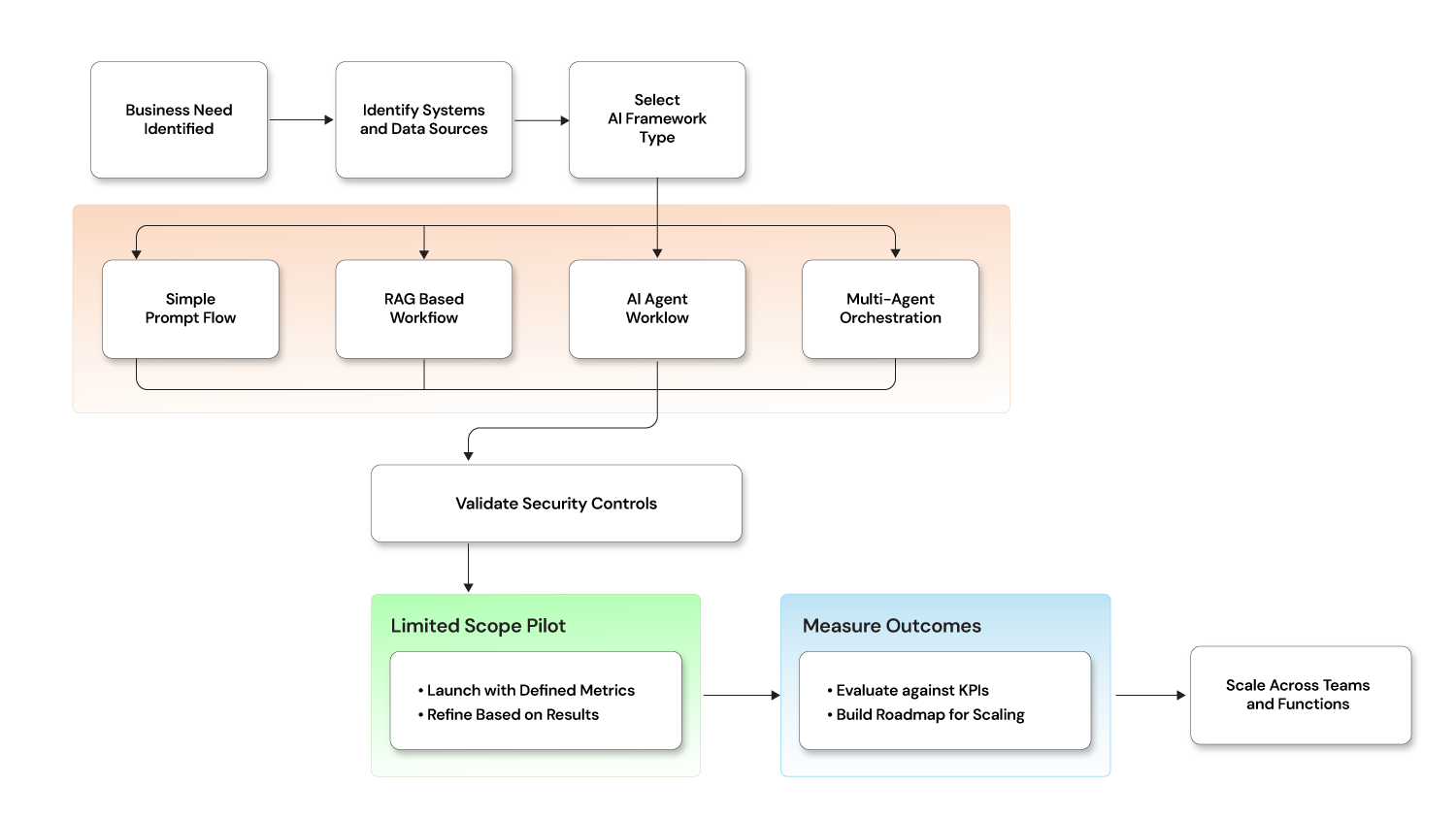
Example logic flow
Step 1: Fetch business data
project_data = fetch_data_from_systems()
Step 2: Validate and sanitize data
clean_data = mask_sensitive_data(project_data)
Step 3: Identify blockers and priorities
insights = analyze_data(clean_data)
Step 4: Generate AI summary
response = agent.run(
    f"Summarize key updates, risks, blockers, and next actions: {insights}"
)
Step 5: Send for approval
approval_status = request_human_approval(response)
Step 6: Publish output if approved
if approval_status == "Approved":
    publish_report(response)
Security validation areas
AI adoption without security controls can create significant business risks.
Before deployment, organizations should validate:
- Access control and least-privilege permissions
- Secure API authentication
- Data masking for sensitive information
- Prompt injection protection
- Audit logging and monitoring
- Human approval for critical actions
- Secure storage of credentials and secrets
- Traceability of prompts, outputs, and actions
Who is responsible for AI security in your product?
For ISVs specifically, this is not optional hardening. Your customers are trusting your product with their data and their workflows. If something breaks or leaks, it is your product that takes the hit, not the framework vendor.
Security needs to be part of how you evaluate and select the framework — not something you bolt on after the architecture is already set.
Security validation checklist
- Role-based access control (RBAC)
- Sensitive data masking
- Secure API authentication
- Prompt injection protection
- Audit logs enabled
- Approval workflow available
- Secrets stored securely
- Monitoring and alerting configured
Choose the right AI framework and build enterprise AI that scales
AI success is not determined by using the most popular framework. It depends on selecting the right framework for the problem you are solving, building strong security controls into the architecture, and designing scalable, reliable, and easy-to-govern workflows.
Engineering teams that do this well will not only automate repetitive work faster. They will also deliver AI features their customers can trust and scale them across the product without having to rebuild everything when requirements change.
If your team is working on AI-driven workflow automation, framework selection, agent orchestration, or security checks, begin with a clear use case and roadmap. Reach out to Opcito’s AI experts to get help from people with real experience.
Comments
Related Blog /Articles





Ready to transform your FinTech Application?
Explore our VAPT as a Service portfolio or speak with our team to discuss your security testing requirements.